Find the Muscles
A gentle lift inward and upward, without tensing your thighs or buttocks.
Organ support, bladder control, posture and intimate sensation — it all comes down to the pelvic floor. Here you'll learn how to find these muscles, how to do Kegel exercises correctly, and how training with Elina Kirilova at MGA Palace helps them work better.
Basics
The pelvic floor is a group of muscles stretched like a hammock between the pubic bone and the tailbone — they support the bladder, uterus and bowel from below. When they work well, we don't even notice they exist: they hold everything in place, help control the bladder and bowel, and take part in every movement — from coughing to squatting.
These muscles aren't isolated — they're part of the deep core system, together with the diaphragm, the deep abdominal muscles and the back muscles. Together they form the body's "inner corset," which supports your posture and protects your spine.
A strong, well-coordinated pelvic floor means better posture, more reliable control when sneezing, jumping or lifting heavy loads, as well as better blood flow and sensation in the intimate area. That's why the topic deserves just as much attention as the abdominal muscles or the back — it's simply rarely talked about out loud.
Abroad, this topic has long been part of everyday conversations about women's health — here it can still feel delicate, even embarrassing. Yet it affects literally every woman: young or mature, active or not, whether she's given birth or not. Understanding how the pelvic floor works is the first and most important step toward training it consciously, instead of by chance.
Signs
The pelvic floor weakens gradually and unnoticeably — due to pregnancy and childbirth (whether vaginal or by C-section), a sedentary lifestyle, menopause (falling estrogen softens the tissues), or regular heavy lifting without proper breathing technique. If you've recently given birth, the topic of postpartum body recovery is covered in detail on our postnatal training page.
The most common signs that your pelvic floor needs attention: slight urine leakage when sneezing, coughing or jumping; a feeling of heaviness or pressure in the lower abdomen; reduced sensation in the intimate area; or a sense that your core "doesn't hold" the way it used to. None of these signs is a reason for shame — they are extremely common, and in most cases respond well to targeted work.
Practice
Kegel exercises (sometimes also called "intimate gymnastics") are a conscious contraction and relaxation of the pelvic floor muscles. The idea is simple, but the execution takes finesse: to find the right muscles, imagine holding back gas while gently lifting upward, as if drawing something inward into your body. Another way is to imagine briefly stopping the flow of urine — only to feel the muscles, not as a regular practice.
These pelvic floor exercises are recommended for women of any age — from young women looking for prevention, to women after childbirth or in menopause. Kegel exercises for women after pregnancy in particular require a more careful, gradual approach, because the tissues are still recovering.
The most common mistake is tensing the buttocks, thighs or abdomen instead of the pelvic floor itself — the sensation then gets "blurred" and the exercise loses its effect. Breathing matters too: don't hold your breath — exhale gently on the contraction and inhale on the release. Contraction alone isn't enough — the pelvic floor works as a team with the deep abdominal muscles, the diaphragm and posture, so training that develops this whole chain gives a more lasting result than isolated exercises at home.
A gentle lift inward and upward, without tensing your thighs or buttocks.
Buttocks, thighs and abdomen stay relaxed — only the pelvic floor works.
Exhale on the contraction, inhale on the release — no holding your breath.
Several times a day with 5-10 mindful contractions give a better result than one rare, long session.
How We Train
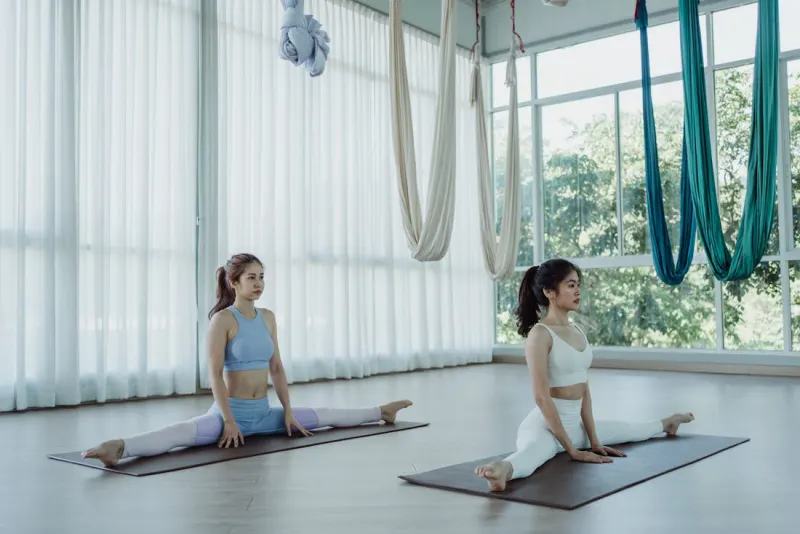
Hi, I'm Elina Kirilova — instructor at Stretching Varna, MGA Palace. Besides flexibility and splits, a large part of our training works exactly on the topic few people talk about openly: breathing, deep stability and the connection between posture and the pelvic floor.
Breathing techniques activate the diaphragm, which works in tandem with the pelvic floor with every inhale and exhale. Pelvic and lower-back mobility releases tension that often keeps these muscles from functioning freely. And a more upright posture automatically reduces excess pressure on the pelvic area throughout the day.
Many women share that after regular training they notice better blood flow, a clearer sense of their body and more confidence — factors that have a natural connection to both intimate life and libido. We work slowly, mindfully, and exclusively in a women-only setting.
I want a free consultation →Important
Training improves the tone and awareness of the pelvic floor, but it doesn't replace medical care. If you feel heaviness or a sense of "falling" in the vagina (prolapse), pain during intimate contact or in the pelvic area, bleeding outside your cycle, or incontinence that doesn't improve after a few weeks of regular practice — see a gynecologist or a physiotherapist specialized in women's health.
We're happy to support your recovery alongside treatment prescribed by a specialist, but diagnosis and medical decisions remain entirely in their hands. If you're not sure where to start, come for a free first consultation — we'll work out together what's right for you.
Frequently Asked Questions
The correct feeling is a gentle lift and squeeze inward and upward, around the body's openings — without tensing your buttocks, thighs or abdomen, and without holding your breath. If your abdomen or buttocks visibly tense while the pelvic floor isn't felt separately, the movement is probably not quite right, and it's worth practicing it with attention to your breathing or in a guided session.
Short and frequent is better than rare and long — for example, several times a day with 5-10 mindful contractions and full relaxation between them. The quality of the sensation matters more than the number of repetitions, and results are usually noticeable after a few weeks of regular practice.
For mild to moderate stress incontinence, regular pelvic floor exercises combined with deep core stability and breathing work genuinely help many women. For more persistent or pronounced cases, it's a good idea to also see a women's health specialist alongside training.
Yes. A stronger and more aware pelvic floor means better blood flow in the area, a clearer sense of your body and more confidence — all of which have a natural connection to libido and satisfaction in intimate life, though results vary individually.
If you feel heaviness or a sense of "falling" in the vagina (prolapse), pain, bleeding, or persistent incontinence that isn't improving — training doesn't replace medical care. In these cases, see a gynecologist or a women's health physiotherapist, and we'll gladly support your recovery alongside treatment. Phone +359 52 999 253.
The Vibe
Explore More
Stretching Varna — home · Pilates Varna · Yoga Varna · Splits & Flexibility · Postnatal Recovery · Online Training · Pelvic Floor & Women's Health
Early Booking
Leave your Instagram or phone number and a question — I'll get in touch personally.
Find Us
location
